Wednesday, November 19, 2008

"Road Verginia Robertivna"

As I write this, I am on the plane home. I left Ukraine at 8:00 this morning (my time), and am due to arrive in Washington, D.C. at 3 PM (10 PM my time).

Here are a few stories from my last days in Ukraine . . .

I spent the week of Fall Break getting ready to go home – writing goodbye letters and putting together photo albums for Ukrainians I know. When you have nothing to do but focus on a departure that’s still weeks away, you (or at least I) can get needlessly stressed out over the details. But I was saved from my obsessive tendencies by a visit from my former cluster-mate, Katie. She had some free time before going to Kyiv for medical appointments, so she came to see Bratslav! Unsurprisingly, Nina cooked up a storm for us, and we got to relax a little.

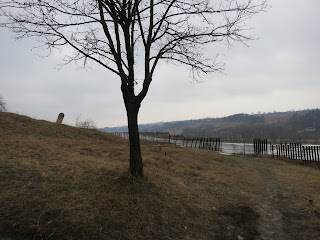
I took her to the Jewish cemetery, and we spent some time looking at the more modern stones. They were really interesting, especially the ones with old photographs. We also visited my school, and talked to my students who were preparing for a regional competition (the Olympiadas). Katie is officially the only other Volunteer to have seen my school’s new sinks! (More on those later.)

As I mentioned in my last post, I didn’t make it to the big Volunteer Halloween party, but my fellow Volunteer Cindy and I had our own small celebration. She was a nudist on strike, and I – as you may have figured out from the pictures – was Sarah Palin. I did my best (and even switched to my “Tina Fey glasses,” which I’ve come to really like), but I suppose that now is as good a time as any to come to terms with the fact that I look nothing like Gov. Palin (and, by extension, Elizabeth Hurley. Does anyone else see that?). Also, I’m not very good at winking.

A couple days later, Clara and I met Katie in Kyiv for the aforementioned doctors’ appointments. It was a very busy three days: we had our various appointments, our close of service interviews with our country director, and our LPI’s (language proficiency interviews). In addition to all that, I spent half the time running around trying to close my PEPFAR grant. Believe it or not, it was difficult to remember the election. It seemed very far away. Even when we sat in our hotel room watching BBC the night before the results came in (remember, we’re 7 hours ahead), I was mostly focused on the math required for my grant’s final budget, and on editing my DOS (“description of service” – an official-type document that you have to write in third person). When Clara and I woke up at 6 AM the next morning, the votes were already tallied! We made it to Katie’s room in time to hear most of McCain’s concession speech (our BBC didn’t work), and stayed for Obama’s speech after that. We had planned on going to a party that the U.S. Embassy was hosting (from 6 AM to 10 AM), but we were tired and still had a lot to do at the office, so our celebration was limited to splitting a persimmon while watching the speeches in bleary-eyed half-disbelief. The PC office has several official photographs of the current President and Vice-President – yesterday, before leaving, I took a “before” picture of them, and maybe a Volunteer with more time left will send me an “after” picture in January!

The rest of our business in Kyiv went well: I closed one grant; survived the “sand-blasting” procedure at the dentist’s; and got “Advanced-Mid” on my LPI! And we enjoyed McDonald’s breakfasts: a new addition to the menu that is only available in Kyiv, so far. We also had dinner with my and Katie’s old Ukrainian teacher, Yulia – who is now married! We met her then-fiancé, which was exciting.

I took my last Ukrainian train-ride home to Vinnytska oblast, and then started the goodbye process in earnest. I gave the English teachers in my town some more resources for teaching about HIV/AIDS, and some goodbye gifts: photo albums with pictures of their schools, and their students at my various seminars; “pesanky” (painted wooden eggs), and letters thanking them for all of their help.

Last Saturday, we had our last big city English club, and a goodbye party for the Group 31ers in our oblast. The next morning, a few of us sat around and watched a DVD of “American Idol” and “The Apprentice” episodes that somebody’s family had sent from the U.S., which filled us with apprehension about returning. But really, what’s the difference? Most of these shows have been remade in Russia and Ukraine, anyway.

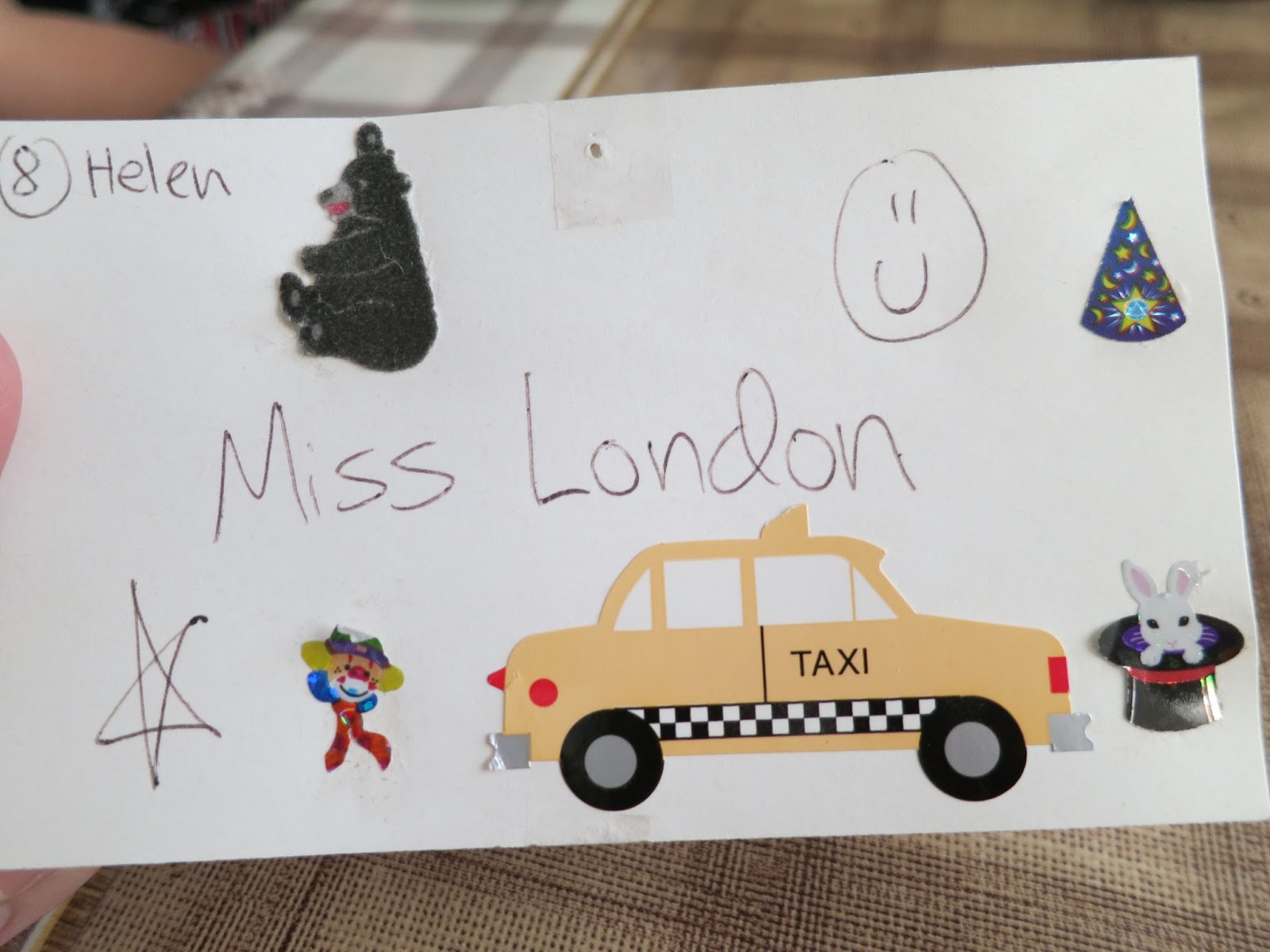
On Monday and Tuesday, I had goodbye lessons for each of my classes. I started by thanking them all for being such wonderful students (which most of them were), and then explaining what a “superlative” is. A Volunteer at our COS conference had suggested that we make superlatives for our students. At first, I didn’t think I could come up with enough, but after returning to school in September, I decided that I could manage. I wrote their superlatives on index cards decorated with stickers, and passed them out at each class. Almost every class had a “Miss” and “Mr. Most Likely to Answer a Question.” A few got “Superstar!”, and many were based on physical appearance – like “Happiest Smile,” or “Brightest Eyes.”

For the 9th grade girls whose names I mix up, I gave “Most Likely to Be Called Olena by Virginia Robertivna” (for Natasha), and “Most Likely to Be Called Natasha by Virginia Robertivna” (for Olena). My 6th graders Yuri and Bokdan were each most likely to try to answer questions before the other one, and the Sasha’s who share a name-tag (with two arrows pointing either way) were most likely to sit together. Quite a few got superlatives like “Quiet Girl,” or “Needs to Talk More in Class” – I couldn’t think of something individual for everyone, especially for the kids who never say anything. Lots of the 5th graders got “Good Luck in English Class!”, and most of the 11th graders got “Good Luck in the Real World!”

In the 7th grade, the girls are almost all wonderful, and boys are some of the most obnoxious students I had here. I couldn’t resist: except for Ihor, who got “Most Likely to Understand Everything and Never Say Anything” (which he understood but declined to read out loud), all of the boys in that class got “The ‘Can You Read This?’ Award” . . . and they could not.

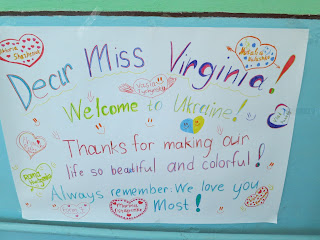
After I gave out superlatives and candy, my coordinator, Lyudmila, asked the students to each write me a note. The notes were incredibly sweet, and contained many interesting spellings of my name (variations of Verdjeniya,” though never quite that bad). The title of this post refers to the best surprise in the bunch: two of my 5th graders gave me notes that began with “Road Verginia Robertivna.” You see, the feminine version “dear” in Ukrainian is “doroHA.” And the word for road is “doROha” – pronounced slightly differently, but spelt exactly the same. I had to explain what had happened to Lyudmila – at first, she assumed that they were referring to my upcoming travels (like a theme Barbie – “Road Virginia Robertivna!”).

Lyudmila was worried about what the letters would say, since this was the first original letter in English many of them had ever written. But they were all very nice, and one 11th grader even said “we begs pardon” for not listening more. By now, the word has gotten out about the Partnership grant that we wrote, and all three school buildings have new sinks with running water. So a lot of the students thanked me “for water,” which sounds a little extreme, but I knew what they meant.

That project is finally done – I turned in the final receipts and finished closing it yesterday. It took a little longer than we expected: there were rain delays in September, and our school director broke his hip last spring – but he came to school just so he could make sure this project was finished, when ordinarily he would have stayed home. So, it worked out perfectly; and again, I can’t say how grateful I am to all of you who donated!

My students asked me why I was leaving, and if I would come back. I said that I wanted to come back, but that I don’t know when. When I explained that my family and friends were in America, some students asked, What if they all moved here? Then would you stay? The 5th graders were vocal in their support, though – they said that they were away at a sanitarium for three weeks without their parents, and that it was very hard. A student from School #1, who always speaks to me even though I don’t teach her, told me that her dad works in Moscow, and that she understands my wanting to be with my family.

In addition to giving gifts these last few days, I’ve been receiving LOTS of gifts. All three of my suitcases are filled with gifts and souvenirs. The only clothes I’m bringing home are those that I needed to wrap around gifts. (Don’t worry, I’m also mailing some clothes home – but still, I definitely need to go shopping soon.)

Some gifts that stood out: Lyudmila gave me a massive blue and yellow pillow in the shape of a fish, because I’m a Pisces; my neighbors gave me a figurine of horse-drawn angels with a fake rose; my students gave me a few drawings, including one of me and Lyudmila (I’m wearing quite a fancy red dress); Lyudmila’s husband gave me vodka for my dad and uncle; and, two nights ago, Clara’s host dad presented me with a mace. That’s right, a mace. The mace is a big Ukrainian symbol because of the association with the Cossacks – and I’m proud to say I was able to fit it in my bag with everything else. Also, I had two poems written for me! I never had a poem written about me before! Yana, Lyudmila’s daughter, wrote a very sweet poem in English for me, and the nice vice-principal (there are two, one is scary) wrote me one in Ukrainian (while she was sitting in a seminar, apparently). Very cute.

On Friday, I had a party for the Ukrainians I’ve gotten closest to: my neighbors, Lyuba and Mikola; Nina (my baba); Lyudmila and her husband; and the English teachers from School #1, the technical college, and the orphanage. Not everyone was able to come, but Nina and I made a lot of food anyway. I made some of the same American dishes that we made at the end of training for our host families – chili, macaroni and cheese, corn pudding and brownies – plus a pizza. Nina made holubtsi (cabbage rolls), which she knows I like, and some other Ukrainian dishes. It was funny to see the Ukrainians exclaim over how interesting the American food looked – and then carefully serve themselves very small portions. Welcome to my life, everyone. The chili was a little too interesting for them, but the blander dishes went over well.

On Saturday night, Lyudmila organized a party at a local café for me and the other teachers from our school. Those teachers haven’t ever talked to me much – I think they don’t really know what to make of me – and Saturday night was no different, but it was still nice to see everyone before I left. There was an hour of dancing to awful disco music, during which I tried to think positive thoughts and focus on how ridiculous everyone else looked. I was totally exhausted, but Lyudmila was really excited to have everyone together. She told me that the school director never used to dance before he hurt his hip – but that night, he put down his cane and shuffled along with everyone else!

The next day was Leaving Day: I had to put all of my stuff on a bus and go to Clara’s town to catch the fast bus to Kyiv the next morning. Clara came over and had leftovers and homemade wine with Lyudmila and Nina and me before we left. It was very hard to say goodbye to both women: they’ve done so much for me, and each regarded me as a member of their family. I gave them both photo albums and framed pictures of us together, which they liked – Ukrainians love pictures, and they can spend hours showing you photo albums without ever seeming to tire (or notice if you do). I did my best to tell them how much they meant to me. Lyudmila was still texting me goodbye’s and thank you’s this morning before I got on the plane. Saying goodbye is definitely one of the most difficult parts of Peace Corps. But it has to happen eventually – and I gave everyone stamped envelopes with my address in America, and promised letters and phone calls . . .

So, I’m finished with Peace Corps! I’m coming home as an “RPCV” – Returned Peace Corps Volunteer. It’s very hard to believe. Here on the plane, I’m not really sure I do believe it.

My friend Grant always tells people “No one ever grows up planning to do Peace Corps; well, except for Virginia.” I’m obviously not the only example, but I guess he’s right that a lot of people seem to stumble upon it their senior year of college, without having given it a second thought before. I’ve wanted to do PC ever since I found out what it was – some time during middle school or whenever I first heard about a cousin who was a Volunteer in Honduras. I felt spoiled my senior year because I only worried about one interview, while everyone else was stressing out over all of their options. You would think that Peace Corps might only delay that stress – but the thing is, you have so much time to think over these two years, that a lot of us leave with much clearer ideas of what we want to do and why. That’s how it’s been with me. So don’t let people tell you that it’s just a postponement of the real world . . .

Despite having wanted to do Peace Corps for so long, I’m not sure that I really expected anything in particular. I thought I would be in Latin America, because I studied Spanish, but beyond that I only had vague ideas of what it would be like in terms of a day-to-day life. I was pleasantly surprised when I found out about how many grant-writing opportunities there were: it just hadn’t occurred to me that as an English teacher in some village, I would be able to take on larger projects that you normally associate with public health programs, etc. Starting to teach about HIV/AIDS and human trafficking at Camp HEAL was a big turning point in my service – RPCVs are right when they say that you start to figure things out after about a year in country. Camp HEAL was also where other counselors told me I should go ahead and try the sink project, even though I was afraid that it was a crazy, unfeasible idea.

I had several ideas crash and burn, and there were definitely some not fun times. With regard to other Volunteers: Peace Corps brings together a lot of very different personalities, and there are many times when the mix doesn’t work (to put it gently). But I met several wonderful, amazing people that I might never have met otherwise, and, even though it’s only been two years, they know me just about as well as anyone on earth does. PC can be intense in a bad way, but it can also be the reverse.

Clara once said that she kept imagining when all this would be a memory, and I said that I kept imagining when it would be a three-minute story at dinner parties. “Where were you in Peace Corps?” “Ukraine.” “The Ukraine? What language do they speak there?” . . . etc.

It’s not an experience that’s easy to define. In some ways, it’s very different for every person – the other Volunteers in my oblast didn’t always understand what things were like at my school, and I didn’t always understand the way things worked at theirs. A lot depends on the people in your town, your coordinator, your students, and other things you can’t control (things which, thankfully, all turned out wonderfully for me). But in other ways, it’s a bizarrely consistent experience: visiting my PC Twin in Mozambique, we found that our situations had many similarities, despite the glaring, obvious differences.

My dad saw an ad for Peace Corps that said “Never have to start a sentence with ‘I should’ve’.” That’s one way to look at it.

But it’s not the only way – I was watching “House,” and heard the following classic line from Dr. Foreman: “It’s like willingly getting the flu, or joining the Peace Corps.” (The Volunteers whom I repeated that to loved it.) He goes on to explain that these things are “short-term . . . commitment is only commitment because it has no expiration date.” He’s absolutely right. There are very few Volunteers who aren’t constantly aware of how many months they’ve finished, and how many are left. The countdown is a frequent topic of conversation in Peace Corps, for obvious reasons. Even if we love what we’re doing, that doesn’t mean we aren’t pining for Target and Taco Bell.

So I’m going home to those things, and I don’t know when or if I’ll ever leave them again. I’m definitely not the Foreign Service type, like some other Volunteers. I hope that I can find other useful ways to spend my time, but opportunities like that aren’t as obvious when it’s no longer your job to look for them. But that’s actually the real reason I wanted to do Peace Corps – to sort of force myself into the habit of being useful, in hopes that the habit would stick.

One more quotation made me think of finishing Peace Corps, from Bill Bryson’s book about walking the Appalachian Trail ("A Walk in the Woods"):

“It was unlike Katz not to fall upon soft drinks and junk food with exuberant lust when the opportunity presented itself, but I believe I understood. There is always a measure of shock when you leave the trail and find yourself parachuted into a world of comfort and choice, but it was different this time. This time it was permanent. We were hanging up our hiking boots. From now on, there would always be coke, and soft beds and showers and whatever else we wanted. There was no urgency now. It was a strangely subduing notion.”

I’m about to be parachuted back into that world, and I can’t say I’m not excited. Mostly I’m excited to see all of you – I’ve missed you since the very first day of staging, before we had even left the hotel in Arlington. I never seriously considered going home early, but there was never a time that I wasn’t homesick. I talked about you all nonstop; and I appreciate how many people kept in touch with me, more than I can say. I hope you’ll be able to tolerate my talking about Ukraine nonstop – but if you’ve kept up with this blog, then I won’t have to bore you with background details (and I can get straight to the good stuff). Thank you so much for reading it!

The last letters I have to thank people for are from Emily H. and Dr. Brent! . . .

By the time you read this, I’ll be in America, so give me a call. I’ll be busy preparing scrapbooks, doing grad school application stuff, and attempting to rebuild my wardrobe – but I won’t be too busy to talk to you.

See you soon!

Love, Virginia

Tuesday, November 04, 2008

Pictures

Some pictures from the disco:


And from a trip to the cemetery with Cindy and Clara:


And some from our trip to Sofiyivska Park:


And finally . . . Halloween. (I was going to go to a big party, but for various reasons we decided not to . . . so we just dressed up on our own):


Wednesday, October 29, 2008

Final Stretch

Hello again! I haven’t forgotten about you. I’m just – as I’m sure you can imagine – too busy to think straight (or write readable sentences). 20 days to go . . .

I’ve officially finished teaching, although I’m going to teach some goodbye lessons before I go. It was a good half-semester; though I think the kids and I were getting a little punchy towards the end. They finally figured out that when I ask them to translate an English word into Ukrainian, I sometimes just take their word for it based on how confident they sound. If they don’t hesitate before translating, and if I don’t know any better, I just assume that they’re right and don’t bother looking it up to make sure. Well, as I said, they figured this out – and tried to trick me a few times, which was cute. One day I asked, “What’s ‘to sprint’?” – and one student said, with as straight a face as he could manage, “Sprint-oo-vah-tay.” (Most verbs end in “oo-vah-tey” in Ukrainian – and there are some cognates, like “pack-oo-vah-tay” (a relevant word for me right now).) Maybe they fooled me a few times and I didn’t realize it, but usually I was able to call their bluff by raising my eyebrows and waiting for them to break. Funny children.

Another time, I was teaching the 7th graders about food, and different things that we should put in the refrigerator or freezer. I said that I could put a Coca-Cola (they don’t say “Coke”) in the freezer for an hour to make it cold . . . but (I asked) what else could I do? What can I take from the freezer to put in my drink to make it cold? One boy, still stuck on the idea of what food products we keep in the freezer, blurted out, “Meat!” Usually I keep a straight face when I’m teaching, but I couldn’t help laughing when I asked “You put meat in your Coca-Cola?” The kids are usually willing to laugh at themselves, too, which is nice.

My star 5th graders are now slightly rowdier 6th graders, but they still did pretty well this quarter, despite the adjustment to a more difficult textbook than they’re used to. Unfortunately, since two very smart girls moved away, it’s a much quieter class, and only a few of the kids are usually willing to read out loud. However, one day, quiet Ruslan volunteered, and managed to make it through a few sentences. When he finished, his friend Yuri turned around and shook his hand in congratulations – so silly. Only men shake hands in Ukraine, and even in schools, you’ll see a boy enter his classroom and shake hands with all of the other boys before taking his seat. They’re very formal, in their way.

About a year ago, my coordinator, Lyudmila, started planning a methodological handbook for teaching the 6th grade: a collection of ten sample lesson plans for a relatively new textbook called “Our English.” Her preparation for this was to take meticulous notes while I was teaching those lessons last fall and again this quarter. So when I helped her edit them, I found myself looking at a record of basically every word I said during those classes. Here’s an example from a lesson in which I was explaining different modes of transportation:

“What’s a carriage? Is it like a train? Does it have wheels? Does it have a sail? Does your family have a carriage? A carriage is a wagon that a horse pulls. (In Ukrainian, you say that a train has ‘wagons.’ In English, we say a train has “cars.” For example, ‘What number car are you on?’) Do you know what a ‘fairy-tale’ is? What character in a fairy-tale had a carriage? She went to a dance, and she had to come back home by 12 o’clock, because her carriage would turn into a pumpkin. Cinderella!

There is also a baby carriage – to push a baby in. [Draw a picture.] There is a poem: ‘First comes love / Then comes marriage / Then comes baby and the baby carriage.’ . . . .

[Looking at a timeline exercise in the (very random) book:] What happened in 1100 BC? The ‘first passenger carriages.’ Like Cinderella – people started using carriages in Europe. Did they use carriages in America? No, in Europe. What is an ‘automobile’? It’s just a car. Big word, short meaning. The first car was in France – when? In 1890. How many years ago? 117 years ago. Did the Romans have cars? No. Did Cinderella have an automobile? No.”

Ok, so I know that this excerpt makes it look like I’m on speed, but you have to factor in the long pauses between questions (which contain, ideally, answers and student participation). But really, that is like a word-for-word account of one of my lessons. It was sort of horrifying to see physical proof of how much I talk, and my utter lack of any brain-mouth filter (this is all pretty much off-the-cuff – I’m not proud of how little I plan my lessons, but there it is). It was strange to relive these lessons as I typed and edited them. The booklet will be printed, with an introduction in Ukrainian by Lyudmila, after I leave . . .

So, I’ve lived in Bratslav for nearly two years, and I still don’t know everyone, but everyone sure knows me. People whom I don’t know never hesitate to speak to me in the street and address me by name (though one man called me “Angela,” which was confusing). On my way to school one day, a woman riding a bicycle stopped to say, “Virginiyechka, you still haven’t left?” No idea who she was. I think I said, “Uh . . . no.” The other day, while I was walking home, a man stopped me to point out a faster route to my house. No idea who he was. I sort of nodded, but defiantly continued along the route I prefer (you have to draw a line in the sand somewhere).

I taught my last big city English club, though we’ll have one more meeting before I go. I decided to talk about a book I had just read – Bill Bryson’s “A Walk in the Woods,” about his attempt to walk the Appalachian Trail. The passages that I read were definitely more appreciated by the more advanced speakers in the group, but everyone enjoyed talking about bears and other dangerous animals. They were all pretty taken aback at the idea of someone hiking for five months for no real reason.

Lyudmila and I finished our PEPFAR project with a disco to raise awareness about HIV. Well, really we didn’t have a disco, so much as an “event.” There was no dancing, outside of the tango choreographed and performed by a few 9th graders. The school administration had had us reschedule the event several times, and in the end, we had to have it right after school instead of in the evening, which meant that no students from other schools could attend. But, as always, Lyudmila went all out, and it was quite a show. She wrote a skit for her new class (the 5th graders) to perform: they all had little paper hats with words like “hygiene” or “vitamins,” and they recited rhyming stanzas about healthy living and the importance of eating right and washing your hands. [Young children reciting original poetry is a very popular form of entertainment here, and it happens at almost every major event.] Then several older students introduced themselves, and performed skits or dances. They had formed “teams” – and each team had their own name, badge, and slogan, in the tradition of the Pioneers (a sort of Soviet Boy Scouts). As I mentioned, a few boys and girls did a tango to Shakira, and others did skits about how eating candy instead of porridge (“kasha”) will make you sick. So, the event wasn’t so much focused on HIV/AIDS, but the students had fun, and the school director and teachers really enjoyed it. Everyone was enthusiastic about planning future projects and seminars with the same theme, after I’ve gone home. So – I’m happy!

I told Lyudmila later that one thing that’s really struck me here is the students’ complete lack of stage-fright. They won’t volunteer to read in class, and they’ll be very shy and retiring in general – but if you ask them to put on a ball gown, do a dance and sing in front of the entire school, they don’t even hesitate. I’ve seen very shy girls get up in front of their teachers and parents and dance in ways that would make Baby from “Dirty Dancing” blush (even after she’d had the time of her life), and then they’ll grab a microphone and sing a solo. It’s amazing. Just the costumes are enough to make my jaw drop, sometimes – one young girl paraded around in a Southern belle-style white hat and poofy dress, complete with wand, at the “First Bell” ceremony this year. I must have had an interesting expression on my face during the tango performance, because the students later ran up to Lyudmila to make sure that I liked it. I did! – and I’m very impressed with them – just sort of surprised, that’s all.

After the “disco,” I went to Trostyanets to visit my friend Clara, and to go to the Halloween party that she organized for the students in her town. It was very involved – all the kids wore costumes, and they had different games like “pin the fangs on the vampire,” and a British version of bobbing for apples where you hang apples from a stick and try to bite them without using your hands. The next day we went over to her host family’s to visit, and made them an apple pie with the apples my coordinator gave me recently. Her host brother and sister speak very good English for their age – they go to a tutor – and are very enthusiastic about talking to us. While eating the pie, her host brother made the enigmatic statement, “There are good things, and bad things.” I said, “Oh?” And he continued, “The pie is good, but it is bad that we don’t have more.”

I’m trying to make sure that I see everyone before I leave, and I was worried about getting to see a former student from my 5th grade groupie class last year, Diana, whose family moved to another town. She was one of the students who called me from time to time (for short conversations, mostly consisting of asking how and where I was), so I had her number, and called her to see if she could come visit me. She came to visit (bearing chocolate and a huge can of strawberries), and told me about her new town and school. I’m still amazed at her English – it isn’t perfect, but she speaks without hesitation. Even if she doesn’t know exactly how to say something, she’ll figure out another way – like when she was giving me directions to her house, she said “You see the school. You see a big blue house . .”, etc. It was nice to see her before I left!

This week, Clara and I took a trip to Uman, a nearby city in Cherkasy oblast. I know I’ve mentioned the sect of Hassidic Judaism that began in my town – Breslov Hassidism. Well, the founder of this group, Rebbe Nachman, is buried in Uman. Every year on Rosh Hashanah, thousands of pilgrims from around the world go to visit his grave. We got to the area where he’s buried, and saw signs in Hebrew everywhere, and one in English advertising kosher food (it seemed like normal kiosk food to me, but it was the off-season). Our taxi driver even did the traditional chant for us (“Uman, Uman, Rosh Hashanah!”). We got to see his tomb, and met a very nice woman who gave us some literature in Russian (which we couldn’t really read), and told us about him. She pointed out where we could make a donation in his name, and assured us (in fairly good English) that Nachman “does favors” even for non-Jews.

Afterwards, we visited Sofiyivka Park: a sprawling park created in the early 19th century, named after Sofia Vitt-Potocka. I’m not 100% sure about her history, but I think she was a slave, then the concubine of someone important, and then the wife of two rich, important men, in succession. According to the guidebook we bought, she was “a very beautiful woman with a big intellect.” As I’m sure you can imagine. [The guidebook also asks, “What is it with Sofiyivka that has charmed numerous visitors?”] The park was very pretty, and it was nice to see all of the fall colors.

Speaking of the weather – it’s been relatively warm! The packing process is sort of a gamble: guessing how much long underwear I’ll be needing before I go, or which sweaters I can afford to do without. The weather’s been good to us, so far – some days, all I need is a fleece jacket! So keep your fingers crossed.

I’ll be spending the next couple weeks doing paperwork, trying to close my Partnership grant (my PEPFAR grant is done, I think), and going to doctors’ appointments and such. I’ll be in Kyiv during the election – so I’ll have internet access at the PC office, and BBC at the hotel! Very exciting!

Thank you to Mrs. Keeley for the nice note! And I’m sorry that so many of you appear to be receiving letters from me three months late! Well, what can you do. I hope you’re all doing well; I miss you – but I will see you very, very soon!

Love, Virginia

Saturday, September 27, 2008

Crimea, and Seminars (Long Entry!)

Hello everyone! 52 days to go. And a whole lot of government paperwork to be done in the meantime . . .

So! For the first two weeks (or so) of school this year, I was sick; so I didn’t do a lot of teaching. Mostly I sat at home and coughed, and ran around town to make sure the four local schools remembered about the seminars on HIV/AIDS that Lyudmila and I were planning. It’s quite a commute to walk to all four schools – my school is right in the middle, and that’s more than a mile from my house – but I’ve really enjoyed getting to know the different English teachers. And the teachers at the technical school almost always ask me to stay for tea and chocolate, so it’s not like I don’t get anything out of the deal.
As I may have mentioned, my coordinator, Lyudmila, and I wrote a PEPFAR grant (the President’s Emergency Plan For AIDS Relief) to hold seminars for the four local schools this month, and to have a disco afterwards to raise awareness. Luckily for me (and, of course, the community) Lyudmila is a powerhouse, and really took the lead with the project’s implementation. We went to our district capital, Nemirov, to print lesson plans to give to the teachers and students, as well as little pocket calendars and brochures with information about HIV/AIDS in Ukraine. Thanks to Lyudmila, we managed to get discounts on a lot of these things, and we’re well within our budget! (That’s particularly impressive given the recent combination of inflation and the antics of the U.S. dollar, which has meant that anyone who wrote a grant last winter (like I did) probably didn’t get quite what they asked for.)

Lyudmila is originally from Nemirov, and on one of our trips I met her mother and step-father for the first time! Of course, her mother insisted on my eating salad and deruny (potato pancakes), which was fine with me. Her attempts to give me something to drink were more problematic: I consider myself a fairly flexible eater (and I’ve gotten better in the Peace Corps), but there are just some lines I don’t cross. For instance, I’ve never once eaten salo, the fried pork fat they love to eat here (though I’ve eaten things cooked with it, which can be good). I have yet to try holodetz, the jellified meat fat dish served here. And, apparently, some liquids here give me pause as well. First she tried tomato juice, which I’ve never been a fan of, which Lyudmila knew and explained for me. Then she offered me milk, and I accepted. She brought me a full glass, with a spoon in it, and explained that it had to be stirred. Because there were chunks in it. Lyudmila said, haltingly, “It is milk that has . . .” “. . . Curdled?,” I asked. I think it was “kefir,” – the “yoghurt” that Nina made by leaving milk next to my electric space heater. I tried it, but couldn’t handle it. So finally, she gave me hot water with lemon. Good enough. They were very sweet; and when I noticed their accordions on the shelf, they played for me – Lyudmila’s energetic mother dancing around, singing and even using her good-natured husband’s face to beat a tambourine-type-thing against.

At the end of the second week of school, my fellow Volunteers Clara and Brittany and I took a trip to Crimea! It was the first trip for each of us, and we had all been told that we had to see it before leaving. I thought that a trip in September would mean fewer crowds, and less oppressive weather – and I was right, but unfortunately, that week the weather in Ukraine turned chilly and rainy all over. We were better off in Crimea than we would have been up north, but still – no sunbathing.

We decided to fly from Kyiv because of a special deal, and to save time – Crimea is a long train ride away (over 20 hours). I realized after it was too late that I had forgotten my real passport, but thankfully they let me through with my PC identification card. Packing for the trip was slightly confusing, because the website clearly stated that liquids were not allowed in checked baggage. We were skeptical, but went along with it – only to discover at the check-in counter that we had been misled. We hastily repacked, and went on our way.

Even though it was September, Crimea was still pretty busy, and we were turned away from several hotels over the course of five days. We finally found a hotel in Simferopol (where we landed), and decided to call ahead before traveling to Yalta. I made the phone calls because I was trying to use the very little Russian I’ve picked up. (In the East, and in Odessa and Crimea, Russian is the dominant language, while in the West, it’s Ukrainian. Clara claims that I pick up a crazy Russian accent when I switch over, that I don’t use with Ukrainian.) We discovered (with the help of someone who spoke English back to me) that Yalta was holding a conference, and so was all booked. (We were later told that this might have been a racecar thing.) So, we went to Bakcheserai instead!

Bakcheserai was definitely my favorite part of the trip; it’s a very pretty town, with many attractions related to its Tatar history. The Tatars are a Muslim minority group in Crimea, originally from Asia or thereabouts. I don’t know much of the history, but it was really interesting to see how different this region of Ukraine was, due to their influence. I heard the Muslim call to prayer for the first time in my life, which was really cool – though we only heard it once, each day we were there.

We arrived, and began to search for a hotel. Lonely Planet told us about a nice bed and breakfast, so we started searching, and ended up following a man up a steep hillside, after which he indicated that we should keep walking straight. After a long, long walk, with all our bags (and under a very threatening-looking sky), we came to a different hotel, which was full. They helpfully called us a taxi, though, and we stopped in a café to regroup, while it started to rain. This café was maybe my favorite part of Bakcheserai: it had couch-like, cushioned seats with low tables, and great Tatar food. The people who worked there were very nice to us, and a man from Uzbekistan walked up to us and immediately began rattling off everything he knew about America, including city names – including Alexandria! He later had some less charming things to say involving conspiracies and UFOs, and we humored him for a bit before returning, with looks of determination, to our plates. He was helpful, though, in that he called up his friend who ran a bed and breakfast down the road! He even got the friend to pick us up in his car, because of the rain, so that was nice. In the meantime, we discovered amazing Tatar desserts, which mostly involve honey, and which include a version of baklava. Tatar food isn’t that different from Ukrainian food – maybe slightly more Mediterranean – but it was still exotic to us, and we loved the desserts.

We met Clara’s training cluster-mate, Christina, who knows all about Tatar culture, as well as Russian politics, and enthusiastically filled us in on some specifics. The room we were given at the bed and breakfast was very nice, and our host greeted us in the morning with Turkish coffee and peanuts covered in powdered sugar. That morning, we hiked up to a monastery in the hills, which was very pretty, and then hiked even further to a series of formerly inhabited (not sure when) caves. It was sort of reminiscent of the Flintstones – the caves often had little openings for doorways and windows carved into them. We took a lot of pictures, posing in the windows . . .

That afternoon, we got to visit a workshop/gallery that I knew about because of the SPA grant that started it: at my first SPA meeting, I think, a Volunteer from Bakcheserai, who was also on the SPA committee, submitted a grant for a workshop/gallery for Tatar artists, to help ensure that their traditional art continued. So, I was really excited to finally see it, after hearing about it so long ago! The workshop was really neat, and the artists came into the gallery to explain their pieces to us (and, of course, to encourage us to buy them). It was all very pretty, and I finally decided on a wedding present for a friend at home (it will be REALLY late . . . sorry, Carolyn!!!).

In addition to Crimean desserts, we got to try Crimean wine, which was very nice. We ate both nights at a restaurant named for Pushkin, where a very nice cat spent the evening first on Brittany’s lap, then mine. So: desserts and wine, pretty art, and a nice cat. It’s clear why Bakcheserai was my favorite stop on the trip.

Our next stop was Sevastopol, where we spent a few hours visiting with a Volunteer couple in our group, Phil and Carol. They pointed us toward “the Panorama,” which Christina was excited to see, and Greek ruins, called Hersonis. The Panorama is a 3D work of art commemorating the siege on Sevastopol at the end of the Crimean War. It’s a circular room that you can walk all around, with a painted scene continuing off the wall (if that makes sense) into cannons, reconstructed trenches, etc. You can see the French and the British approaching in the distance. They even made the room smell like gunpowder (apparently there is a recording of gunshots and explosions that they play when lots of children come). I’m not very knowledgeable about history, and the whole thing made me think of Eddie Izzard’s imitation of the Germans retreating from Russia (“Oh – it’s a bit cold, a bit cold!”).

We took a very late bus to Yalta, where we stayed in a nice apartment. Unfortunately, the palace that hosted the Yalta Conference (of FDR, Churchill and Stalin fame) was closed, so we satisfied ourselves with a ferry trip to the Swallow’s Nest: a very, very small castle on a cliff, built at the beginning of the 20th century, for someone’s mistress. It was on the cover of the last Lonely Planet for Ukraine, and is very photogenic, but, as Lonely Planet warned, much shorter than you would expect. (Like meeting a celebrity in person, they crack.) It’s about the size of a suburban house. But I was still happy to see it, finally, and we all took lots of pictures, when not ducking out of the photos of Ukrainians. Asian tourists might be famous for how many pictures they take, but I swear, no one can out-do Ukrainians at the random, “glamour shot” photo. Every two feet, at least, there was a Ukrainian girl draping herself against a wall and gazing dramatically at her friend’s camera (no smiles and peace signs for Ukrainian photos). It was pretty intense.

The next day, we woke up early for our journey back to our sites. This required the following sequence of modes of transportation: a marshrutka (minibus); a bus; a taxi; a plane; a bus; a train; a taxi; and a bus. Needless to say, it took all day, and we were all very tired when we reached our respective homes. However, exciting tidbit: I met someone who spoke Spanish on the train! I was complaining to Clara about not knowing the word for “blanket” (wanting to request one from the conductor), and how I knew it in Spanish (whine, whine) – and the guy across from me must have understood some of what I said, because later he asked, in Spanish, if I spoke Spanish. I was so shocked and unprepared that, even after a few tortured seconds of thinking, I was only able to respond with “sí” and “entiendo” – “I understand” (which I did . . . I just couldn’t really respond). For basic words, my mind immediately goes to Ukrainian, but after a few minutes I was able to carry on a conversation with him, and learned that he’s been working construction in Barcelona for four years. So, my Spanish is not totally dead!

Back in Bratslav, Lyudmila and I continued with preparations for our seminars. That weekend, we went to the store and bought 140 juice boxes – individually. Not so many “in bulk” options in Ukraine. We were a sight to see.

On Monday, the seminars began! We invited (and confirmed the names of) five dedicated students and any interested teachers from our school, the technical college, School #1, and the orphanage – and that’s more or less who came. Unfortunately, the students and teacher from the orphanage never did show up – apparently there were various competitions to attend, which took priority. Sigh. By the end of the week, we had lots of new students, and very few who had actually attended all four days. So, the “before and after” tests we gave on Monday and Thursday have little to no statistical value, but whatever.

On the first day, Lyudmila and I went over the lesson plans I’ve been using to teach about HIV/AIDS here, which my campers had translated into Ukrainian for our seminar participants. Usually I don’t care too much about grammar when I speak Ukrainian during these lessons – I figure, if I can get the main point across, I’m good. But this time, I was speaking in front of my former Ukrainian tutor (the Ukrainian teacher at our school) and the vice-principal, in addition to other teachers and students who hadn’t heard me before, so I was a little nervous. I tried hard to use the right grammar, and people were very nice about complimenting me afterwards. We did the elephant and lion game, and I went over the true/false questions about how it’s possible to get HIV (sharing needles, yes; toothbrushes, no). I noticed that the vice principal had sort of a stern expression on her face, and I was nervous that she was offended, so I kept trying to smile and direct my lighter comments towards her. But afterwards, she came up to me, looking like she was about to cry, and thanked me and Lyudmila for the seminars – so I had no reason to worry, after all.

Lyudmila was very enthusiastic while explaining the lesson plans with me, and the first day was great. The second day, I wanted to show part of “A Closer Walk,” but, unfortunately, the CD I burned on my computer didn’t work with our new TV and DVD player, so I ran home to get my computer. A student claimed to be able to read the Russian subtitles from the back row of chairs, but he must have been lying: soon after starting the movie, I realized that most of the thirty-some people in attendance had no idea what was going on. I was panicking, but they came up with the solution of having someone in the first row read the subtitles out loud. Everyone was satisfied with this, and I was thrilled – an English teacher from School #1 and Lyudmila took turns reading, and it went very well. My former tutor told me afterwards about how she got our 80-year-old literature teacher to come see the movie: at first she wasn’t interested, after hearing what the subject matter was, but she came anyway, and later thanked my tutor for convincing her. It was wonderful to have such enthusiastic and appreciative participants, even though they didn’t all come every day. The whole point of the project was to encourage teachers and students to continue teaching about HIV after I leave, and to feel confident with the subject matter. So I was very, very happy with the reactions we got – I think we were successful!

On the third day, we invited two speakers from a nation-wide organization I had come across, named ACET (AIDS Care Education Training). They were great! The students and teachers loved them, and they covered everything in a straightforward way, with humor – really, I felt like I was in a “family life” class at home (yes, that’s what my crazy high school called it). My Ukrainian isn’t so good that I could understand all of the jokes, but I could see how much everyone was enjoying the presentation. The speakers were impressed with Lyudmila’s attitude and she with theirs, and they may come back to our school again!

On the final day, the different school groups were to plan their own projects (like at Camp HEAL, where campers sit with their Volunteers at the end of the week to plan something for their community). Unfortunately, as I said, many of the students hadn’t been there all week, or couldn’t come on the last day: there was some concert thing at the technical college, so they couldn’t come, and only four students came from School #1 (and not the ones who came before). Apparently there was some driving school thing on Thursdays that no one bothered to tell me about beforehand. But, it was an enthusiastic audience anyway, even if it didn’t have the sense of “closure” that I planned for.

Before the students started planning projects, Lyudmila taught an extra lesson on “healthy living,” which was a surprise to me. I was a little skeptical, since her preparation had including cutting out lots of pictures of cute, fluffy animals, and making flowers and grass from colored paper. [Side note: Ukrainians really like to make things pretty. Really. Students may not have any clue what the test in front of them is about, but they will have the white-out ready to be employed at a moment’s notice. Women might alternate between two sweaters all winter, but you had better believe that both will be covered in sequins and flair. If they have one pair of boots, you’d better believe they’ll be pointy stilettos – never mind that Bratslav’s uneven roads are hard on my feet even when wearing sneakers. It’s just a priority, here.] Lyudmila had the students make collages using the pretty pictures of nature and fluffy animals, and she posted them on the blackboard. She then said (and I’m paraphrasing, from what I understood of it) that these represented a nice, healthy life. She asked if the students had enjoyed making them – and, sure enough, they had. She then said: well, this is what happens to your life when you get sick (again, paraphrasing, she was probably more eloquent) – and she began ripping the pictures off the posters, and crossing out the flowers. The students cringed and caught their breath, but they smiled and understood the lesson. Then, she said that your friends and family might help you, take care of you, and take you to the hospital – and she began to glue some of the pictures back into place. But the damage was done, and she explained that life can’t be totally the same again, afterwards. Which is why we should live healthy lives. I was impressed!

So, the seminars went very well! I was especially pleased with the teachers’ reactions; they were really excited about the lessons. At my school, I’ve had very little contact with any adults besides Lyudmila – the teachers say Hi to me (sometimes), but that’s about it. So it was nice to have some of them there at the seminars, so that they could understand more about what I’ve been doing all this time. If these seminars are what I’m remembered for, then I’m happy!
I’ve finally started teaching regularly again, although I won’t be for much longer! It’s too bad that I won’t get to know my new students better. My new 5th graders – Lyudmila’s new class, now that her 11th graders are gone – are very, very cute. They’re very intent on translation: I can barely get out a sentence before a child shouts out what he or she thinks the Ukrainian is. There are a few enthusiastic new students in my other grades as well – including a girl who gave her name as “Meri,” in the 7th grade.

This year, we only have six 10th graders – a result of all the smart students (and some others) transferring to the technical college after 9th grade. But – it’s great! Because they’re all at the same level. This is very rare in my classes: I usually have four kids who understand everything I say, six kids who don’t have a clue, and about ten somewhere in between. It limits what I can do – especially what I can do for the kids who are behind. These six don’t have a high level of understanding at all, but I can go slowly enough that we’re all on the same page. They get tired of looking things up in the dictionary (as I repeatedly request that they do), but they’re actually engaged – not just staring off into space – so I’m happy.

One more story about teaching: the other day, I was teaching a text about trying to understand new words, for my 7th graders. The text suggested that we guess what part of speech the new word is, in order to understand it, and that we look at the context. So I decided to have them guess some words I knew they wouldn’t know. I used the sentence, “Mr. Brown has a new plant. It is a rhododendron. It is mauve.” I was trying to get them to guess that a rhododendron is a plant, and that mauve is a color (or at least an adjective). This led to the following exchange:

Virginia Robertivna: What’s a rhododendron?
Olha: [random Ukrainian word]
VR: I don’t know what that is.
Lyudmila: (laughs at VR)
VR: What?
L: She said “rhododendron.”

So clearly, Olha is too smart for her own good. But the class got the overall point, as well.

As I said, it’s gotten cold and rainy, and for most of September, Nina didn’t have the heat on. (It’s ok, I have a space heater.) Usually, I take cold/lukewarm “showers” (with water pressure that couldn’t drown a daddy-longlegs: I know – I’ve tried), but because of the weather, I finally considered an alternative. I had been wary of bucket baths because I was worried about running out of water mid-bath (my hair has gotten really long) and having to heat up more with wet, soapy hair. I did the bucket bath thing in Mozambique, and, sure enough, it took as much water as I could carry to get my hair clean. But what I realized – as a recent bucket-bath convert – is that, when in my own house with a bathtub inside (and not down a path, like in Mozambique), I don’t have to only use as much water as I can carry! So, now I’m a believer. It is so nice to wash my hair with warm water that I don’t even mind how much time it takes to boil it.

In other news, I’ve been baking a lot: I made brownies, oatmeal chocolate chip cookies, and chocolate chip banana bread for the seminar participants. I think I’ll be doing a lot of baking in the next month or so, too – baked goods tend to be my default gift for Ukrainians, and I’ll need something to give all the people I have to say goodbye to. My Regional Manager, Natasha, came by this week, and while she was talking to Nina about how soon I’m leaving, Nina started to cry, and then Natasha started to cry . . . and oh man, this is 52 days from the finish line. Wish me luck.

Finally, thank you to Katie B. for another “time-capsule” card! I don’t mind – after all, my favorite movie (“The Muppets’ Christmas Carol”) urges us to make Christmas “last all year.”

I hope you’re all doing well!! Thanks for reading this very long post . . . see you relatively soon!

Love, Virginia

Friday, September 05, 2008

Seminars, COS conference, etc.

Hello, again. 74 days left! Pretty crazy.

When I last wrote, I was relaxing at my site, and battling fleas in my room (fun). But I was soon on the road again, this time to help at a summer camp and a week of training seminars.

First, I visited Grant’s camp in Vinnytsia, to teach about HIV/AIDS. He had told me that his students knew everything on the subject, and were very smart, so I had nothing to worry about. So I was a little taken aback when I learned, shortly after I arrived there, that the campers were mostly in the 4th and 5th grades. Most of his regular students, it seems, were busy. I was in shock, but he kept saying “It’ll be fine, don’t worry.” I said “I know it will be fine – because I’m not going to teach the lesson I had planned . . .”

So, I focused on biology and stigma, rather than transmission, and – as Grant marveled afterwards – I didn’t say the word “sex” once, during the whole 45 minutes. It turns out that my cartoonish rendering of the immune system (the T4 cell is Superman) works well for 9-year-olds, and they really liked the lion and elephant game. (Have I described this game before? One person is the “baby elephant,” surrounded by “elephants” who link arms to protect the baby from the “lions.” After one trial attack, I tap several elephants on the shoulder, and send them back to their seats, leaving just two. After that, the lions have no problem getting to the baby. The message: the baby elephant is the body; the elephants are the immune system; the lions are germs like the flu or tuberculosis; and HIV is what reduces the immune system to the point where it can’t fight the germs.)

Grant asked them to make posters about what they had learned, and they did a really great job! One that I liked in particular had a group of people from different countries standing in a circle with linked arms around someone with HIV – saying that even though the person’s immune system couldn’t protect him, these people would. Aw.

From there, I went to Clara’s site to help with the teacher training seminars she was holding in honor of her new English resource center. Fourteen teachers from around her district came to learn about the communicative method, etc. Again, I taught about HIV, and passed out all of my lesson plans and materials for them to use if they wish. The teachers had varying levels of English, so I tried to go through my lesson plans in Ukrainian as quickly as I could, to fit it all into an hour and a half. As it turned out, I went too fast – and we finished a half hour early! Ukrainians don’t usually ask questions after presentations the way we Americans like to, so that was that.

A couple days later, it was time for me to leave for our group’s Close of Service conference (COS). In preparation for the long trip west, I stopped in Vinnytsia to buy new earphones. I don’t do much shopping here, but it seems that the following story is pretty standard. First, I had to put my luggage somewhere, and it wouldn’t fit in the lockers by the door, so I had to leave it by the stairs and trust the guards to keep an eye on it. I found someone to show me where the earphones were, and then had to find someone to cut the ones I wanted off of the display shelf, where they were tethered. This set off an alarm. Then they told me to go to the “kasa,” or counter, where I waited for a few minutes completely alone until a guard bothered to explain that I had to go to the kasa upstairs. This required going through a gate, which set off another alarm. Upstairs, I was given a receipt approximately twenty-five pages long, and returned downstairs, where I was told I couldn’t go through the most convenient gate, but had to go back around through the store to another one. Finally, I surrendered half of my massive receipt to the guard, collected my luggage, and was on my way . . . with a new pair of earphones.

On our way to the conference location in Slavske, outside of L’viv in the Carpathian mountains, my friend Clara and I went through Ivano Frankivsk, a city south of L’viv. It was very pretty, and a nice place to wander around and relax. There are several historic churches, and we ate in a Moroccan restaurant! The next day, continuing with the ethnic food theme, we met Brittany and her former training clustermates Angela and Diana for Japanese food in L’viv. Very fun. The following morning, Clara and I got up early for our train, and inadvertently caught part of Michelle Obama’s speech on BBC at our hotel! The hotel where we had our conference had BBC as well, and several of us woke up at 5 AM to see Barack Obama’s speech a few days later.

At the COS conference, Clara and I realized that we had both forgotten our bathing suits – and there was a pool there! So we walked down to the bazaar in town, and picked up matching tank-top and shorts sets that said “Sports Happy,” which did just fine as makeshift suits.

The conference was very nice! There were 82 of us, I think, out of the 84 remaining in Group 31. We were told that we’re the largest COS group ever, even though we weren’t the largest coming in! There were definitely several people I didn’t know at all, and another Volunteer and I spent the first dinner quizzing each other in lowered voices about the unfamiliar faces at the table.

We had several presentations on opportunities after PC, and learned about grad schools, teaching programs, the Foreign Service, and how to write a resume. That was all very interesting, but it was also nice to just sit around and catch up with people, some of whom I hadn’t seen in almost two years!

One of the highlights of the conference was the superlatives: “most likely to” etc. Grant and another Volunteer were in charge of these, so I had been hearing hints about mine for months. I had never had a superlative before (my high school stopped the practice because they were getting too mean), so I was pretty nervous. Well, the suspense is finally over: mine was “Most likely to COS early to strengthen the Obama presidential campaign.” Ha. See, a lot of my fellow Volunteers are from way out west, and different places like that (Montana or God knows where), and they’ve never really met anyone so plugged into politics before. So, I’m a bit of a novelty. I’ve tried to explain that I’ve never even worked for a campaign (and it’s not like I haven’t had opportunities in D.C.), but they just smile and shake their heads. I think I’ve said this in this blog before: I can’t always be “the cute one,” so I guess I’ll settle for being “the political one.”

Clara was the “most genuine,” and Brittany was the “nicest Volunteer.” Did we girls in Grant’s oblast get immunity or what? Overall, they were less harsh than I had feared.

I was afraid that we would spend the whole week at the hotel, and that I wouldn’t end up really seeing the Carpathian mountains, but I did! They paid for us to go on a chair-lift up into the mountains, where we had a beautiful view. It took a half-hour to get up there, and then again to get back down, so we were pretty far up.

On our second-to-last night, one of the Volunteers in our group organized an “open mike” event. Well, I had had the same song stuck in my head for three days . . . and I had always wanted to try performing at one of these things . . . so I signed up! I was plenty nervous, I can tell you. And drinking does bad things to my voice, so there was no liquid courage to be had. It made me feel better to see that other people performing were nervous too, and in the end I made it up there without collapsing. Somewhere in the middle of the second verse, I realized that I was singing. It went well!! It was sort of a melodramatic Appalachian song about saying goodbye, and allegedly I made people cry. (Not that I was lucid enough to notice at the time.) People were very sweet about complimenting me afterwards, and I’m glad I did it! It was fun.

The other performances were fun to watch (especially after mine was over)! We had a couple of sing-alongs, and some original poetry readings by the Volunteer who organized the night. Two Volunteers did a dramatic reading of a story from the 9th grade Plahotnik textbook – involving “the typhus” and a dead dog – complete with bongo drums! The Volunteer who had been voted “best storyteller” told about an interesting establishment where she used to work as a hostess, which was hilarious. And another Volunteer read a long, funny poem that ended up mentioning all 84 of us – though I had just left the room when he read the line about me! I think it was something like “Virginia endures life near Grant.” How true.

On the last night, we had a special dinner complete with live traditional Ukrainian music. The band later followed us to the outdoor bar, and we even did a traditional Ukrainian dance! (Mostly you dance around in a circle, so it wasn’t too difficult.)

I arrived home at the end of the week to discover that we have a new puppy! He’s very cute, black with tan spots, and his name is Zhuk – “bug,” in Ukrainian.

Back here at home, I continue to be very spoiled by Nina – she frequently brings me hot Ukrainian dishes like borsht or holubtsi (cabbage rolls), and it’s very nice. Before COS, I invited my Camp Heal girls over to work on our project, and Nina helped me peel fruit to make a dessert for them beforehand. It’s just very nice to have someone around to help me out when I need it!

Since COS, I’ve been running around: visiting the schools in Bratslav to tell them about the seminars that Lyudmila and I are having at the end of this month. It’s going to be a very busy fall, and I have a feeling that my teaching will be sporadic. At COS, we had several meetings about how to finish things up and say goodbye, and I felt like it was a little premature to be thrust into the “goodbye” mode when we still had a couple of months left. But now that I’m back at site, I’m thankful: I have a lot to do before I go, and it’s helpful to already be in that mindset!

One more thing: according to the Facebook version of the Myers Briggs test, my personality has changed in Peace Corps! I took the test twice! There’s no denying it. Instead of being an ENTJ (“The Executive”), I’m now an ESTJ (“The Guardian”). This shook me up quite a bit. I looked it up, and it seems that the difference between N and S is as follows: S, or Sensing people “like to take in information that is real and tangible – what is actually happening,” while N, or Intuition people see “the big picture.” N people “trust inspiration,” while we S folks “trust experience.” So, I suppose that’s not such a bizarre reaction to the Peace Corps experience, now that I think about it.

Thank you to Katie B., Melanie A., Steph and Kristen for their letter! It was like a time capsule! It took me a second to understand why Katie seemed to think I hadn’t met her fiancé yet – and then I saw the date on the letter. Haha. Better late than never!!

Hope all is going well at home! I was happy to see that Hurricane Gustav wasn’t as bad as people were afraid it’d be. Keep in touch – see you fairly soon!!

Love, Virginia


P.S. These last pictures are from the First Bell ceremony, a few days ago . . .

Saturday, August 16, 2008

94 Days To Go

Hello again! I don’t have much to report, but things have been going well. I’ve mostly been taking it easy and working on various projects (like Project: Research Grad Schools) . . . but somehow, I’ve made it past the 100-Day Mark! So, that’s exciting. It’s about the only exciting thing I have to say.

A few days after returning from Mozambique to visit my PC Twin, I went to our big city English club to show off pictures from the trip. They were well-received, and one of our club members told me a funny joke connected with the many students who come to Vinnytsia from warmer parts of the world (Asia, Africa, and the Middle East). The joke goes: an African student’s family asks him how the Ukrainian winter is. He writes back that the “green winter” isn’t that bad, but the “white winter” is deadly . . . haha.

Later that day, I went to buy train tickets with my fellow Volunteer Matt. He only had to buy a few, but waited patiently for me to buy thirty-two. See, in order to get to a summer camp across the country in Donetsk oblast, I was going to have to take two trains each way – and I was taking seven campers with me. It took me about an hour to buy them all . . .

My campers and I were bound for the same camp went to last summer: Camp HEAL. H.E.A.L. stands for “Human trafficking, Education, AIDS, and Leadership.” Last year I took three girls, and taught about HIV transmission and prevention; this year I worked the system in order to take seven, and taught about trafficking. One of my girls was a “junior counselor” this year, because she came with me last year, and had studied in America.

My group was composed of: two girls who were with me last year and are in university; two from School #2, one of whom is entering university this fall; two from the local technical college; and one whose mother used to teach at the technical college. What made things even more fun was the fact that I had three Yana’s and two Aliona’s . . . there are not enough Ukrainian first names, in my opinion. Keeping track of all seven throughout the various train rides was interesting – walking through the stations, it was like Make Way For Ducklings. It’s funny how, even though the girls pro
bably understand transportation in Ukraine much better than I do, I was always the default leader because I’m older, and “the teacher.” I did okay, though. We even picked up an 8th when we were nearly there – Olya, a girl who recognized me on the platform from camp last year! So, I was quite the mother hen/duck.

Camp was good! I met some new Volunteers; including the amazing Megan, who was in charge of organizing the camp this year. The only major drawback, for me, was the lack of an office where we could gather: last year, we were able to spend our free time together in a nice room with chairs and trashy teen magazines, but this year our office had no chairs and was half-flooded. Oh well.


One addition to the camp’s schedule this year was a talent show! One of my girls, it turns out, it a very talented hip-hop dancer. We began to refer to her as “Madonna.” Another one of my girls is also very talented at belly-dancing, but, unfortunately – due, perhaps, to the too loose knotting of a few scarves – her dancing was a little more exotic than I think she had planned. There was a bit of a wardrobe malfunction. Bless her heart, she kept a smil
e on her face – and another counselor pointed out later that if you’re going to be dancing in your underwear anywhere, it might as well be Ukraine. (Summer outfits here can get pretty skimpy . . . you can pretty much see most girls’ underwear all the time, whether they’re dancing or not.) Everything turned out fine, and I eventually recovered from the anxiety attack I suffered sitting in the audience . . .

On the last day, my girls and I took an excursion to a nearby monastery. It has caves – like the Pecherska Lavra in Kyiv – where monks are buried, but unfortunately everything but the museum was closed when we got there. The outside of the cathedral was pretty, anyhow, and we stuck our hands in the healing fountain. Then, I gathered my ducklings, and we began the long trip back to Vinnytsia.


Speaking of my oblast – there is a new Lonely Planet (tour book) out, that includes Vinnytska oblast! And, what’s more – it even includes my town, Bratslav!!! Yay!! Seriously: go check it out, in Barnes & Noble or something.

I’ve seen many funny t-shirts recently, but I can only remember the two I saw at the monastery: “I’m a Serious Guy” (red letters on the back of a black and white striped t-shirt), and “How Can I Be So Thirsty Today When I Drank So Much Last Night.”

The only new cooking adventure I’ve had was making oatmeal chocolate chip cookies, which I doled out to the various families I know here . . .

Thank you very much to Alyssa for her beautiful, artistic card, and to Gigi for the postcard! I’m working on sending out one last, massive batch of letters before I go . . .


So, that’s it! I hope everything’s going well at home. I miss you all, but I will see you relatively soon . . . keep in touch!


Love, Virginia

Tuesday, July 15, 2008

Miss Virginia in Africa

(Disclaimer: this is really long. It’s ok to take breaks. Whatever you need.)

Hello again! I’m back from my trip, which was probably one of the coolest things I’ve ever gotten to do in my life. I think I was in awe for the majority of the time I was there, trying to soak up as much information as I could. I’ll do my best to summarize . . .

First, some background: I call my friend Katie my PC Twin, because our service dates are almost identical. She left, I think, six days before I did, and we’ll both be getting home around November/December this fall.

These dates, however, are the only obvious similarities between our situations. As you know, I teach English in a secondary school in Ukraine (where it is now summer), and I speak very little Ukrainian in class. Katie teaches Biology in a secondary school in Mozambique (where it is now winter) – and she teaches in Portuguese! I was able to pick out other similarities between our worlds, but you have to be paying pretty close attention to find them . . .

After I arrived in Ukraine, I started thinking about how cool it would be to see what Katie’s life in Mozambique is like. Because of our respective service dates, my only chance to see her in action was during my service. I kept the idea on the back-burner of my mind for a while, and finally, with the help of my parents and frequent flyer miles, I made it!


The trip from Bratslav to K
atie’s town took four days, which was a little intense. I spent one night in Kyiv, one night in Paris, and one night in Johannesburg. The only other people on the very small plane from Johannesburg to Vilanculos seemed to be South Africans on vacation. One asked me if I was going to the islands . . . I was like, There are islands? I was very ignorant, but ready to learn. Looking back at Katie’s old e-mails from twenty months ago, it makes me feel better to see her talking about the pet giraffe she assumed she’d acquire. (It turns out there isn’t actually much wildlife there, due to landmines and the civil war which lasted some twenty years after Mozambican independence in 1975.)

Vilanculos is a small city on the coast near where Katie is serving. As I entered the tiny airport, knowing I would have to buy a visa, I suddenly realized that I had assumed there would be an ATM, or someone who would accept a credit card. With a rising feeling of panic, I watched other tourists coolly hand over American dollars, and tried to think of a solution. My best options, I decided, were: to convince the man to accept the equivalent amount in Ukrainian hryven; to borrow money from a tourist in the hope that the adjoining room had an ATM which would allow me to pay him back five minutes later; or to find Katie. Just as I reached the front of the line and started trying to explain, to a man who didn’t really speak English, that I didn’t have dollars but that I could offer an alternative – Katie appeared out of nowhere, speaking rapid-fire Portuguese and saving my life. As soon as I registered who she was and what was going on, I gave her a hug and felt very relieved . . .


Katie had advised m
e to travel light, and thankfully I did: I had just my purse, backpack and a shoulder bag. She knew what she was talking about: it’s about a 3 km walk, I think, from the airport to the center of town. I started to notice a few similarities to Ukraine – like the goats tied up on the side of the road – but also, obviously, many differences as well. As we walked, kids called out to her – but not just the requisite “Good morning” we Americans hear in Ukraine (at all hours of the day). She explained that they were asking for money, or various other things. Her response, which appeared to be a reflex, was to demand money from them, or a trade: their t-shirt for money. Apparently a few kids have reacted to this offer by starting to strip – and she then has to say, Ok, I was just kidding. I heard her do this many times during the trip, and the kids (many of them her students) thought it was hilarious – a pretty effective response, I think!

We did eventually get to an ATM, and then caught the equivalent of a marshrutka (a mini-bus) back to her town. My Spanish was slightly helpful: for example, I understood whenever people asked Katie if I understood. Understanding was a lot easier than responding; I generally left that part to Katie. Although she lives 60 km from the city, the trip generally takes about 2 hours. I peppered her with questions about Mozambique and her life, and took in the scenery during a brief off-roading detour to deliver groceries to someone’s house.

Katie lives with another Volunteer, Lauren, who is an English teacher, and they have a site-mate who was on vacation. Their house is nicer than most, as it was built by a South African oil company, which also built their school. The third Volunteer teaches English at an orphanage run by an Italian Catholic mission. I was fascinated by how they had set up their house; it’s the fourth place Katie’s lived in so far, counting a hut she shared with a former Volunteer which was destroyed by the cyclone in February of 2007. I think it’s common in PC posts (other than Ukraine) to give Volunteers, especially girls, site-mates. This might be for security reasons, but Katie explained that it’s also to maintain sanity: I’m the only American in my town, but it’s easier for me to visit the Volunteers around me, and we get together fairly often. For Katie and her site-mates, traveling is more of a pain, and they try to avoid it.

The major difference between my set-up and theirs (besides the fact that I live with a baba) is the lack of running water there. (I think at least 60% of Volunteers in Ukraine have running water . . . but that’s a total guess.) However, they’ve set up what I think is an ingenious system with PC-provided water filters. They have more filters than the average Volunteer there: Katie assumed that hers had disappeared after the cyclone, and got new ones, but found the other two later. They have a faucet-less sink that drains, so they simply set up one of the filters on the edge – and it’s like having a real sink! The toilet was another story, but it was fairly nice for a latrine, and here’s the kicker: they have real toilet paper! Not, as my former cluster-mate Luke used to call it, “Cardstock.”

The first night, I lay awake listening to a bug buzz nearby me for a while, wondering which side of the mosquito netting it was on, but soon fell asleep. In the middle of the night, however, I was woken by the sound of shouting, singing and drums. I kid you not. I have no idea what the men were shouting and singing about, but it was pretty loud. Katie heard it too, and had no explanation for me. I often heard groups of people singing and chanting there, which could usually be explained by the many churches around town: everything from Catholic to Methodist and Jehovah’s Witness. It didn’t happen again, or else I slept through it the next time . . .


The next mo
rning I slept late, and then fixed myself bread with garlic and butter. You see, I was determined to avoid mosquito bites, and mosquitoes usually love me (I still complain about the night of 42 bites, last summer). I had read that garlic and B-1 vitamins would help, so I brought both. I think the fact that it was technically winter helped more than anything; the temperatures where roughly where they are in Ukraine now, but there weren’t many mosquitoes out. I got just four bites – on my hand and elbow – which convinced me that Deet is still better than other remedies, since those are the places I probably missed when applying repellent.

I spent the morning looking around. Katie recently had a fence built around their yard for privacy, and I discovered that you can see bobbing water jugs pass by on the other side – but not the women’s heads beneath them. It’s pretty funny to watch the progress back and forth to the well.


Later, I visited Katie’s school and met some of the students. She was supervising a tes
t, and had the same problems with rampant cheating that I encounter here. However, she has a few teachers at her school who feel the same way she does, and she was given license by that particular class’s teacher to be as strict as possible. So she went from desk to desk, finding cheat sheets in every possible location, including students’ pockets. The students just laughed genially – a reaction I found all too familiar.

I’ve decided that I’m grateful for my country’s Puritanical roots: say what you will about excessive guilt, but it saves a lot of time when it comes to things like test-taking. I know that cheating goes on in American schools too, but the difference is that I would have been devastated if a teacher caught me cheating (which, ahem, would never have happened, but still). As in Ukraine, the fear of grades being changed surreptitiously necessitates a strict no-mistake policy in the official grade registers. If something is crossed out, you have to rewrite the entire book. Volunteers in Ukraine deal with this by refusing to mark grades in the registers – but Katie and Lauren had to record their classes’ grades themselves, first carefully in pencil, and then in ink. (Another difference between the countries is that Katie and other Volunteers are put in charge of “termas,” or classes, like homeroom teachers – and I don’t think that ever happens here.)


So, I came during a very busy time in the school year: there was lots of test-taking and grading going on. I was h
appy, though, to just sit around and take in my surroundings. You can see the ocean from Katie’s backyard, and they keep the back door open all day, so I could feel I was enjoying the outdoors while remaining in the shade. Another big source of entertainment for me was Katie’s dog, Timanga (“peanut,” in the local language), and her six adorable puppies. That’s right, puppies. This was essentially the perfect vacation for me: sitting around and playing with puppies. Also, Katie got a bunch of mail delivered from their PC office, which included a letter I sent her in late March, and a lot of “People” magazines. So between the magazines and everything else, I felt pretty spoiled.

Because there is no running water at their house, they have to monitor how much water they have pretty closely. Katie used to get her own water at the well, and even learned how to balance the massive jugs on her head. She carries things balanced sideways on her head, using one hand, as opposed to the women and girls there who routinely walk around with massive things balanced upright on their heads, not using their hands at all. I don’t mean to criticize Katie’s abilities in any way – I found that I could not even lift those jugs, when full. Not even an inch off the ground. Now, they pay a student named Justina to get their water for them every day. Another girl, Alzira, maintains their yard and does odd jobs for them. Both girls were very funny and sweet, and were among the many students and others who regularly hang out at Katie’s house. “Miss Alzira” called me “Miss Virginia” (she learned this habit in English class), and was excited to tell me that her mother is also named Virginia. This means that I’m her mother’s “shara,” which essentially means “namesake” in Portuguese, but applies to all people who share a name.


An almost constant presence at Kati
e’s house is a thirteen-year-old boy named Pedro. He’s very quiet, and just sort of hangs out in the doorway, observing what goes on. He was very sweet about tolerating my pathetic attempts to speak Portuguese. Eventually he got more comfortable with me and tried out his English. Before the trip, I asked Katie if I could bring gifts for anyone, and she told me about Pedro: so I brought him a bright yellow t-shirt with a Cossack-style smiley face that says “Don’t Worry, Be Ukrainian.” Ha. My attempts to translate the shirt weren’t very successful, but he seemed to like it, and wore it several times before my departure.

We did a lot of cooking while I was there: I was impressed with how much they cook and bake (they have a small electric oven, as well as a gas stove top). One unfortunate aspect of life in Mozambique is that chocolate is rare and expensive. However, the girls have as much of a sweet tooth as I do, and were creative in making up for its absence. I contributed by making lemon squares and brownies, and Lauren made an amazing oatmeal cake with coconut.


Speaking of which: I lea
rned how to shave coconut from its shell! Here in Ukraine, the must-have kitchen apparatus is the cabbage shredder. Down there, it’s the coconut shaver. You sit on a little bench, and use a ridged blade-like thing on one end to get the coconut out. Unfortunately, I’m not very good at it (or wasn’t, on my first try) and gave myself a minor cut after finishing half a coconut. Luckily, one of the omnipresent students was able to take over for me, which he did with a smile.

Katie took me on a couple of long walks to get me out of the house, and I got to see the beach, and a lot of gorgeous scenery. Timanga joined us for some of the walking, which unnerved those around us – Mozambicans are not very fond of dogs. All of the students who passed us spoke to Katie, if only to address her, saying “Stora,” which is short for “profesora.” It was really cute. The biggest hit, though, was whenever she said one of the short phrases she’s learned in the local language (shitswa). People went nuts when she broke out one of those phrases; they just loved it.


One of the highlights of th
e trip was giving the puppies a bath. They were adorable, but covered in fleas. Katie had some anti-flea soap, so we stuck them in a little tub, two at a time. They were so curious and excited that some were trying to climb in before it was their turn; they were not happy when their turn came, though, and they realized what a bath involved. But in the end, they were much softer and fluffier, and had fewer fleas.


Another highlight was the acquisition of a chicken for our 4th of July celebration. Frozen chicken is sometimes available at the store, and Katie has only made chicken the old-fashioned way two or three times, but they wanted m
e to have the experience, so we bought a live one from the school. I was all for it, and volunteered to kill it myself . . . but later, I was relieved that I didn’t have that job when I saw how long it took our handy-man, Pedro. When knives aren’t sharp, it’s a little more involved, to say the least. I did help pluck it though . . .


Another day, Katie
and Lauren were curious to see what Ukrainian food was like. Clara sent the recipe for “holubtsi” (cabbage rolls) to me via text message, and I decided to make those and fried potatoes. Unfortunately, we didn’t have tomato juice to cook the rolls in, and tomato sauce didn’t turn out to be very effective as a substitute: they were pretty dry. However, they now have the recipe, and, given Lauren’s enthusiasm in the kitchen, I wouldn’t be surprised if she perfected it later. I also had real Ukrainian vodka for them: the morning I left, my coordinator’s daughter, Yana, arrived with mini-bottles of Nemiroff vodka for me (made just twenty minutes down the road)! I brought the original and cranberry flavors, and we toasted the dry holubtsi like real Ukrainians.

On Thursday night, I went to the Catholic service with Lauren, during which I understood hardly a word, though the music was very pretty. On a couple nights we went out to restaurants – of which there are several on the beach, because it’s a fairly touristy area. The second night I was there, we went out with two PC Mozambique staff members who were visiting the site, which was really interesting for me. One had been to D.C. for a PC training, and had visited Pentagon City (yay!). He had met members of the Ukraine staff, but no one I knew. They were fascinated by my PC ID badge, which, I must say, is pretty fancy. We’ve unfortunately switched to a cheaper version since my group came, but the two staffers were definitely intrigued, so maybe Mozambique Volunteers have fancier IDs in their future!

During the day, we took a lot of trips to the market, which was set up much like the bazaars we have here, except that people who sell things sit on the ground, instead of on chairs, and the only products that they weigh before selling are things like flour. The market is nearby their house, but Katie and Lauren have discovered how to take advantage of the students constantly hanging out in the yard. When they don’t feel like walking to the market or when it just seems too stressful (the way I feel about the bazaar here), they “mandar,” or send, a kid with some money. It’s pretty convenient! One morning, Katie and I were walking in the market, when she saw a few teachers drinking at one of the stands. They’d been drinking all night, and Katie didn’t want to deal with being asked to join in, so, with just a few yards to go, she grabbed a student and sent her with money to buy eggs at the stand. It was really funny. The student thought nothing of it, though she laughed when she came back to find Katie hiding behind another stand.


As you can s
ee, I could go on and on, but I’ll try to wrap up this account. On Tuesday, we caught a ride from a transplanted South African to Vilanculos, to pick up Katie’s friend Eron, who was coming to visit for even longer than I had (I think she’ll be there for a month!). Katie and Eron and I went to stay at a hostel, which meant sleeping in bunk-beds with mosquito nets in a hut! There was a massive baobab tree out front, which I was excited about, because I’d been curious about what they look like ever since reading about Kenya in Barack Obama’s first book.

The next morning, we got up early to go see the sunrise on the beach, which I’d never gotten around to doing in Katie’s town (though I easily could have – she gets up at 5:30, most days). The fence gate was locked, so we climbed over it and sat down on the beach to watch. When it was pretty light outside, I went swimming! I didn’t like the idea of seeing a new ocean without getting in, so even though it wasn’t particularly warm outside and no one wanted to join me, I went in. It was really nice! As it got lighter, people began to walk by us. It was interesting: upon seeing Katie, most Mozambicans seem to assume that she’s a tourist or an ex-pat South African, and they pay her no mind. But as soon as she says “Bon dia” or “Boa tarde,” their faces just light up. Most people were extremely friendly to us. Not many more people seem to know what the PC is down there than do up here, but they get the gist. Katie explained to everyone that I was “mandar”-ed up near Russia, just like she was sent to Mozambique, and they all responded, Wow, that’s far away. I agreed.


That last morning was when I got my souvenirs: shells I found on the beach, and two “kapilanas” – th
e cloth that women wear like a sarong, carry their babies in, or fold underneath the various things they carry on their heads. They’re quite useful, and the markets sell them in many different patterns.

Another Volunteer was being given a ride to the airport in her school’s pick-up truck, and they stopped to pick us up along the way; I think it was the first time I’ve ever ridden in the back of a pick-up! I figured out all the stamps and fees required for me to leave the country, and said goodbye to my wonderful hostess and her new guest. The trip back was more direct, but tiring, as I had no break between the three flights. I got on a train to Vinnytsia, where I discovered that the following day was a holiday – and there were barely any buses. Luckily, I ran into an English teacher from the technical college, and we managed to find a bus to Nemirov, from which we took a taxi – and I finally got home about 10 pm.


Since then, I’ve been relaxing and doing lau
ndry, and enjoying some real holubtsi, courtesy of Nina. The one exciting thing was when I laid out my sea shells the night I got back . . . and one of them moved. That’s right. I was half-asleep, but managed to think of throwing it in a zip-lock bag: whatever’s in there won’t last long. The next morning, I got up and examined the others, and they seemed to be fine and inanimate. Then I found one of them on the other side of the room. It, too, is now sitting in a plastic bag in my closet, where it won’t creep me out anymore. Never a dull moment.


I have a quiet couple of weeks ahead of me, but plenty of thin
gs to get done before my next excursion . . .


So, thank you so, so much to Katie for having me! It was really wonderful, and definitely a highlight of my PC experience. And thank you to my family who helped me get there!


Finally, thank you to Clarissa for the nice note! That’s about it. Hope y
ou’re all doing well at home . . . keep in touch!


Love, Virginia